A closer look at Claude Fable 5.2
I wasn’t expecting a new model from Anthropic today. Then I looked closer at its launches this year: 13 release days through November 9, compared with five in the same period last year. That’s 2.6× the launch pace. The releases are coming quickly enough that a workflow you ruled out a few months ago might already be worth another look.
I’m curious how much recursive self-improvement will contribute to this. In its November 5 report, METR estimated that Anthropic’s benchmark improvement rate had accelerated 1.9× since October 2025, with AI assistance likely explaining most of the current acceleration. Better AI is helping researchers build the next model faster. That’s probably going to be one of the most interesting developments we’ll see in early 2027.

5 in 2025 → 13 in 2026
Anthropic
Now back to Fable 5.2. Usually, when we evaluate a new model, we look at our composite benchmark suite, the Agent Index. It combines seven benchmarks covering reasoning, coding and professional work to help you compare capabilities that matter when you put a model to work. Fable 5.2 currently ranks #1, with 89.6/100.
We also compare capability with cost, because the question for your business is how much reliable work you can get for the money:
Agent Index vs Cost: Find the best value for knowledge work
Combined cost = (input price + output price) ÷ 2, in USD per 1M tokens: 500,000 input and 500,000 output tokens.
Each model uses its lowest reported current provider rate, excluding Flex and batch tiers. Point tooltips identify the provider and both prices. Caching and tool fees are excluded; actual task cost depends on token usage. Benchmark results may use a different provider or configuration.
The cost axis uses a nonlinear logarithmic scale, adjusted to include $0. Lower prices are spread out and higher prices are compressed; equal spacing does not mean equal dollar increments. Prices and scores are unchanged.
The dividers are the median cost and Agent Index score of the plotted models. The upper-left quadrant has above-median capability at or below the median cost.
Compare AI models on knowledge work capability and token cost, using our seven-benchmark Agent Index.
- Fable 5.2 does more for less money. It scores 89.6 on the Agent Index, against 83.4 for Fable 5.1 and 86.2 for GPT-6 Astra, while costing 20% less per token. If you already use Fable 5.1, that’s a useful combination: better reported results and a lower token bill.
- Higher token prices don’t always mean higher costs. Fable costs 2× more per token than Opus for just 0.4 more points on the Agent Index. But what matters is how many tokens it takes to finish a task. On FrontierCode 2.0, Fable at High effort achieved nearly the same score as Opus at roughly half the cost per task.
| Reported result | Fable 5.2 · High | Opus 5.5 · Max |
|---|---|---|
| Score | 45.3% | 45.5% |
| Average cost per task | $6.72 | $12.82 |
| 1,000 similar attempts | $6,720 | $12,820 |
That’s a $6,100 difference across 1,000 similar attempts. At High effort, Fable’s smaller token bill outweighs its higher rates in this setup. These are average costs per attempted task, including unsuccessful runs.
Now, what does that actually buy you? A few of the reported results made me think about agency margins, work that can run overnight, and which skills become more valuable as agents take on more of the production. Let’s get into those.
Benchmarks explained
Benchmarks don’t tell the whole story, and your real-world tasks may produce different results, but they’re a useful indicator of where a model’s capabilities are improving.
Remote Labor Index
Freelance project completion
Hardware prototyping could be the next big wave.
Fable’s tool-assisted CAD reconstruction score jumps from 44.4 to 83.5, almost doubling. That means better results turning reference designs into editable geometry. If small teams can explore more versions before paying for extensive engineering work, I’d expect new AI businesses around hardware prototyping. The opportunity is cheaper design iteration, with engineers still checking what can actually be built.
BenchCAD 2.1 · with tools
CAD design reconstruction
Let your agents take the night shift.
Give an agent a well-defined engineering job, a working environment and tests, and it can keep going while you’re offline. Fable scores 69.9% on long-running engineering tasks, up from 56.3%.
There are concrete examples in Anthropic’s launch report: Uber describes a 10 to 12-hour security audit that returned a write-up and fix pull requests. Inside Anthropic, an engineer had Fable coordinate more than 1,000 subagents for eight days to build a prototype operating system that booted on a laptop. Those are the kinds of runs that make the night-shift idea tangible.
FrontierSWE v2
Long-running engineering work
Agents can finish over half the business workflows in this test.
Fable completes 51.4% of business workflows end to end, up from 31.4%. The test covers sales, marketing, finance, support, operations and HR across 47 apps. Think about a sales handoff: identify the right company, update the CRM, apply the routing policy and send the next person the context. You can hand an agent the whole sequence instead of prompting it through each step. Carbon leads this test at 53.9%, so you have more than one model worth considering for this work.
AutomationBench
Business workflow completion
Legal work still needs people who know the law.
Fable’s all-pass rate is 7.2%, compared with Grok’s 9.4%. Every requirement has to be met without a material hallucination, and the models still struggle.
I expect more well-paid legal evaluation work as labs try to close this gap. Mercor already lists legal AI-training projects at $100 to $150 an hour, and Surge AI recruits legal specialists into its expert network. Writing demanding test cases and catching mistakes in model answers requires the expertise these models are still missing.
Harvey LAB-AA v1.1
Reliable legal deliverables
More of your agent’s code is ready to merge.
Fable’s score on producing mergeable code jumps from 32.4% to 49.1%. If agents handle more of the implementation, there’s more value in understanding a client’s problem, connecting their systems and getting the solution into production. That’s the work of a forward-deployed engineer (FDE).
The hiring data is already moving: Pave ranks FDE as its second-hottest tech job in Q3 2026, while Top FDE Jobs counted 1,465 postings across 499 companies in October. My bet is that better coding agents make this combination of customer judgment and hands-on engineering even more valuable.
FrontierCode 2.0
Mergeable code changes
Use High effort for routine coding before paying for Max.
Fable scores 56.9% at High and 60.0% at Max. Moving to Max buys another 3.1 points while using roughly 3.6 times as many output tokens. For routine fixes, High is a sensible starting point; save Max for difficult changes that benefit from more reasoning. Across thousands of coding tasks, the effort setting can make a substantial difference to your bill.
CursorBench 4.0
Multi-file coding tasks
High uses about 72% fewer output tokens than Max.
Fable 5.2 is your research intern.
Remember when OpenAI said it had reached its automated research-intern milestone, with agents already running throughout its researchers’ daily work? Fable gives you a way to put that idea to work yourself. It scores 74.6% on scientific workflows, up from 52.6%. You can ask an agent to set up a computational experiment, write and run the analysis code, compare outputs, and collect the results for you to review.
Terminal-Bench-Science 0.1
Scientific workflow execution
Better at reading charts.
Fable goes from 44.8% to 73.4% on reading professional charts, without tools. You can ask it to pull quarterly values from a chart in a client’s deck, compare trends across reports, or identify which segment drove a change. Carbon is close at 72.5%, so the big improvement here is over the previous Fable.
Chartography · no tools
Professional chart reading
Turn a folder of files into client spreadsheets and presentations.
Think about a client project that starts with research, source documents and several spreadsheets. You need to reconcile the information, build an analysis and turn it into a presentation someone can use. AA-Briefcase tests this kind of complex knowledge work, with linked tasks and thousands of source files. Fable reaches a 66.1% rubric score, up from 61.5%. It leads on meeting the requirements, while Opus has the higher combined quality rating, 1800 Elo versus 1785.
AA-Briefcase v1.1 · rubric
Professional deliverable quality
Build and audit financial models for client work.
For example, you could give an agent a company’s financial statements and ask it to build a revenue forecast, check the formulas and prepare a memo explaining the assumptions. Real-World Finance tests building and auditing financial models and producing client-ready work. Its grader preferred Fable’s output to Opus’s in 74% of comparisons. Fable missed the three-hour deadline on six of 123 tasks, though, so this looks more useful for an overnight analysis than a spreadsheet you need just before a meeting.
Real-World Finance v2
Financial analysis quality
Anthropic is already working this way
Anthropic says Claude now writes over 90% of the changes merged into its core codebase, with human guidance. That’s a useful glimpse of where this is going: people setting the direction and reviewing the work, with agents doing more of the implementation.
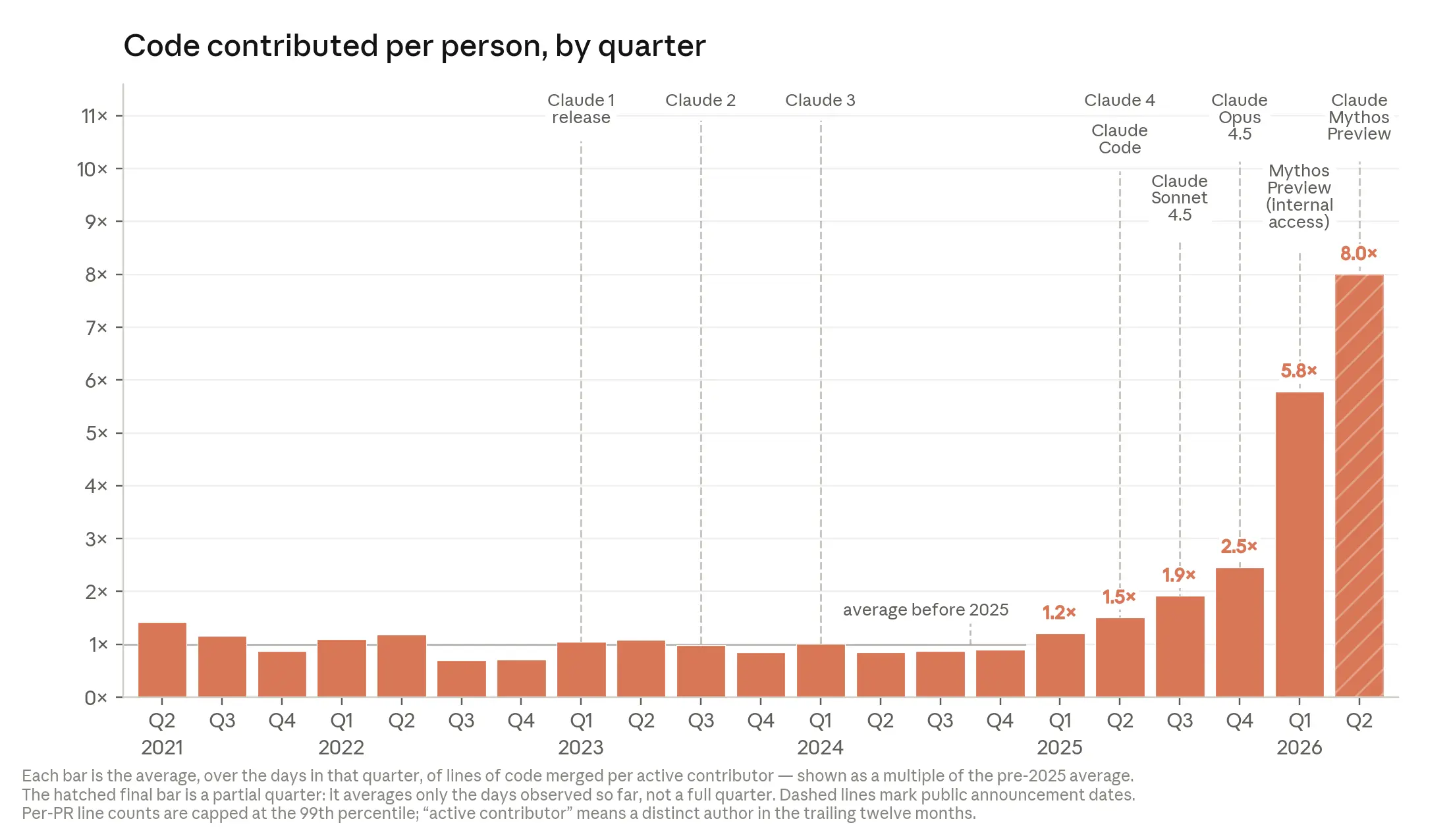
The company’s earlier report included this chart of code output per engineer. Imagine the same change in a small agency. If implementation speeds up, the ability to define the right project, judge the result and get it into a client’s hands becomes a bigger part of what the team is selling.
Blended token cost comparison
Fable 5.2 costs $8 per million input tokens and $40 per million output tokens, 20% below Fable 5.1. Optional Fast mode doubles those rates to $16/$80.
A run with 100,000 uncached input tokens and 20,000 output tokens costs $1.60, down from $2.00. For an agency selling a substantial client project, the larger opportunity is reducing the hours someone spends producing and correcting the work. Saving forty cents is useful. Saving a revision cycle could change the margin on the job.
Blended token cost
USD per 1M tokens · 50% input + 50% output · lower is better
Pricing details and sources
Blended cost = (input price + output price) ÷ 2: 500,000 input and 500,000 output tokens. Each model uses its lowest sourced current provider rate, excluding batch and Flex tiers. Cache discounts, tool fees and workload-specific token usage are excluded. 52 models without complete sourced current prices are unavailable in this comparison. The default selection is this model and the nine closest in blended cost; if this model has no price, we show the ten cheapest. The scale stays fixed across pages of your selection.
| Model | Input / 1M | Output / 1M | Blended / 1M | Provider / source |
|---|---|---|---|---|
| Claude Haiku 5.5 | $0.10 | $0.50 | $0.30 | Anthropic ↗Standard API, prompts up to 100K input tokens · Checked 2026-11-02 |
| GPT-6.1 Terra | $1.00 | $5.00 | $3.00 | OpenAI ↗Standard API, prompts up to 272K input tokens · Checked 2026-11-02 |
| Claude Sonnet 5.5 | $2.00 | $10.00 | $6.00 | AmazonClaude Sonnet 5.5 (max with fallback) · Checked 2026-11-02 |
| GPT-6.1 Sol | $2.00 | $10.00 | $6.00 | AzureGPT-6.1 Sol (max) · Checked 2026-11-02 |
| Claude Opus 5.5 | $4.00 | $20.00 | $12.00 | AmazonClaude Opus 5.5 (max with fallback) · Checked 2026-11-02 |
| Gemini 4 Argon | $4.00 | $20.00 | $12.00 | Google (Vertex)Gemini 4 Argon (high) (Vertex) · Checked 2026-11-02 |
| Gemini 4 Carbon | $4.00 | $20.00 | $12.00 | GoogleGemini 4 Carbon (high) · Checked 2026-11-02 |
| Claude Fable 5.2 | $8.00 | $40.00 | $24.00 | Anthropic ↗Standard uncached API · Checked 2026-11-09 |
| Claude Fable 5.1 | $10.00 | $50.00 | $30.00 | AnthropicClaude Fable 5.1 (max with fallback) · Checked 2026-11-02 |
| GPT-6 Astra | $10.00 | $50.00 | $30.00 | AmazonGPT-6 Astra (max) · Checked 2026-11-02 |
Opus still gives you a serious alternative at $12 versus Fable’s $24 per million blended tokens. A more capable model earns its premium when the extra ability changes the result: it finishes a difficult analysis, fixes a stubborn bug, or returns a file that takes less human work to make useful.
That’s also why I wouldn’t put every part of a service on the same model. Extracting fields from a form and working through a difficult client problem have very different requirements. Cheaper models can do the routine steps, leaving the expensive reasoning for the parts that need it. Your cost per finished job includes the retries, tools and human time along the way.
Output speed compared
Our endpoint snapshot puts Fable at about 103.4 output tokens per second, compared with 89.6 for Astra. For long answers and generated files, faster output can reduce some of the waiting.
Output speed
Output tokens per second · higher is better
Measurement details and sources
Output speed measures generated tokens per second. Each model uses its fastest sourced current provider report. Batch and Flex tiers are excluded. Provider, configuration, prompt and reporting methods can differ, so these are reported observations rather than controlled head-to-head tests. 64 models have no qualifying sourced speed report. Defaults include this model and the nine closest reported values, or the ten leading models if this model has no report. The scale stays fixed across selected pages.
| Model | Output speed | Provider / configuration | Measurement | Source |
|---|---|---|---|---|
| GPT-6.1 Sol | 342.946 t/s | OpenAI (Ultrafast)GPT-6.1 Sol (max) (Ultrafast) | longmedianArtificial Analysis: GPT-6.1 Sol (max) (Ultrafast); host OpenAI (Ultrafast); standard uncached input/output pricing. TTFT is the first streamed token, which may be reasoning. Retrieval time is not measurement time; region/concurrency/quantization not specified in this record. | SourceChecked 2026-11-02 |
| Claude Sonnet 5.5 | 144.019 t/s | GoogleClaude Sonnet 5.5 (max with fallback) | longmedianArtificial Analysis: Claude Sonnet 5.5 (max with fallback); host Google; standard uncached input/output pricing. TTFT is the first streamed token, which may be reasoning. Retrieval time is not measurement time; region/concurrency/quantization not specified in this record. | SourceChecked 2026-11-02 |
| Claude Fable 5.2 | 103.417 t/s | AnthropicStandard uncached API | Prompt not specifiedStatistic not specifiedUSD per million uncached input/generated output tokens. Fast-mode speed multipliers are not absolute measured throughput. No TTFT inferred. AA max-effort/default-fallback first-party output-speed summary. Its first-answer latency is not TTFT and remains unpopulated. | SourceChecked 2026-11-09 |
| Claude Opus 5.5 | 97.19 t/s | AmazonClaude Opus 5.5 (max with fallback) | longmedianArtificial Analysis: Claude Opus 5.5 (max with fallback); host Amazon; standard uncached input/output pricing. TTFT is the first streamed token, which may be reasoning. Retrieval time is not measurement time; region/concurrency/quantization not specified in this record. | SourceChecked 2026-11-02 |
| Gemini 4 Carbon | 94.625 t/s | GoogleGemini 4 Carbon (high) | longmedianArtificial Analysis: Gemini 4 Carbon (high); host Google; standard uncached input/output pricing. TTFT is the first streamed token, which may be reasoning. Retrieval time is not measurement time; region/concurrency/quantization not specified in this record. | SourceChecked 2026-11-02 |
| GLM-5.2 | 94.073 t/s | Z.aiGLM-5.2 (Max) | source aggregatemedianExplicit first-party AA measurement; reasoning configuration retained. Cross-provider medians are excluded. Retrieval time is not measurement time. | SourceChecked 2026-11-02 |
| GPT-6 Astra | 89.577 t/s | AmazonGPT-6 Astra (max) | longmedianArtificial Analysis: GPT-6 Astra (max); host Amazon; standard uncached input/output pricing. TTFT is the first streamed token, which may be reasoning. Retrieval time is not measurement time; region/concurrency/quantization not specified in this record. | SourceChecked 2026-11-02 |
| Gemini 4 Argon | 87.964 t/s | Google AI StudioGemini 4 Argon (high) AI Studio | longmedianArtificial Analysis: Gemini 4 Argon (high) AI Studio; host Google AI Studio; standard uncached input/output pricing. TTFT is the first streamed token, which may be reasoning. Retrieval time is not measurement time; region/concurrency/quantization not specified in this record. | SourceChecked 2026-11-02 |
| Grok 4.7 | 87.436 t/s | SpaceXAIGrok 4.7 (xhigh) | longmedianArtificial Analysis: Grok 4.7 (xhigh); host SpaceXAI; standard uncached input/output pricing. TTFT is the first streamed token, which may be reasoning. Retrieval time is not measurement time; region/concurrency/quantization not specified in this record. | SourceChecked 2026-11-02 |
| Claude Fable 5.1 | 69.417 t/s | AnthropicClaude Fable 5.1 (max with fallback) | longmedianArtificial Analysis: Claude Fable 5.1 (max with fallback); host Anthropic; standard uncached input/output pricing. TTFT is the first streamed token, which may be reasoning. Retrieval time is not measurement time; region/concurrency/quantization not specified in this record. | SourceChecked 2026-11-02 |
But an agent building a feature also spends time searching files, running tools and waiting for tests. Those endpoint numbers won’t tell you when the feature will be ready. The interesting speedup is an agent getting through more of that work without stopping for you. That’s what can let a solo founder move another project forward during the same working day.
Community reviews
I’m interested in what happens when these models land in the tools people already use. Cursor’s coding setup and Perplexity’s research setup put the same model to different kinds of work. Their results help show where the upgrade might reach you through an existing product, before you build anything yourself.
Cursor
Cursor’s result is interesting because much of the performance survives below Max effort. There’s room to improve your coding agent without paying for the most expensive setting on every task.
At max effort, it's the top model on CursorBench at 60%.
Cursor · November 9, 2026
Perplexity
Perplexity reports 0.851 at $14.51 per research task in its own setup. A cost per completed task is useful when you’re deciding whether to include research in a service you sell. This is a separate evaluation from Anthropic’s offline WANDR result.
On our WANDR benchmark, it achieved Pareto frontier of performance and efficiency, with a record score of 0.851
Perplexity · November 9, 2026
Matt Shumer
Matt is excited about what he can build and frustrated by the restrictions. Both can be true. A model’s willingness to carry out the work is part of how useful it will be in your product.
The things I created with it are mind-blowing. It’s also basically a school hall monitor.
Matt Shumer · November 9, 2026
A detail worth keeping in mind when you see the specialist demos: Fable and Mythos share an underlying model, but their access and safeguards differ. Some cybersecurity and biology results belong to restricted Mythos configurations.
The opportunity I keep coming back to is a small team taking on work that used to require more production capacity. That could mean a development agency shipping more client work, a researcher running more experiments, or a hardware team exploring more designs. The people who can define a worthwhile job and recognize a good result have more to work with after this release.
AI-powered agencies have a margin opportunity.
This is the result that makes me think about agency economics. Fable completed 41.3% of the freelance projects in the evaluation, up from 17.9%. That’s roughly four in ten projects meeting the human professional’s standard, compared with fewer than two before. If you sell a finished deliverable for a fixed fee, reducing the production hours leaves more of that fee in your business. You can take on another project, spend more time with the client, or keep the margin.